

How to Help Your International Child Feel They Belong in Denmark
Moving to Denmark is an exciting adventure, but it can also be challenging for young children. Beyond learning Danish, international children need something just as important: the feeling that they belong.
As a Brazilian mother raising two daughters in Denmark, I discovered how even small moments of representation can make a big difference.Because when you move abroad and have children there, you quickly realize something: your children belong to two worlds.
They celebrate the traditions of the country where they live.
They grow up speaking another language at home.
They visit grandparents in another country.
They answer questions like, “Where are you really from?
And sometimes… They don’t quite see themselves reflected in the world around them.
As a Brazilian raising two daughters in Denmark, I’ve watched this happen in small, almost invisible ways.
Their classmates were mostly blonde. The children in many Danish books looked different from them.
The cartoons they watched rarely featured families that looked like ours. None of these moments were dramatic on their own. But together, they quietly send a message about who belongs.
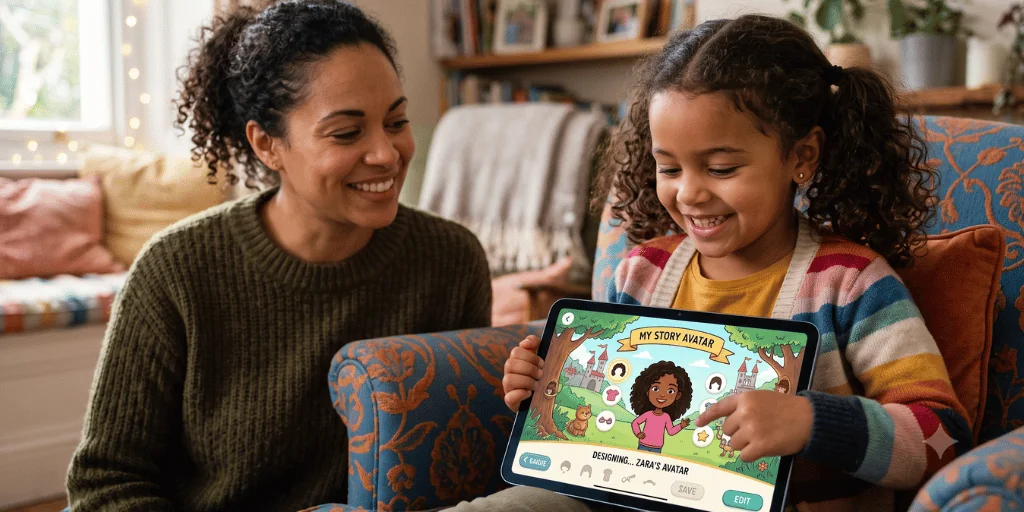
So, one of the most magical moments in building Poikilingo didn’t happen after a successful launch. It didn’t happen when we reached thousands of families. Or when we received Google’s Teachers Approved badge. It happened in my own living room. My daughters were among the very first children to test a version of the app where they could build their own avatar.
They carefully chose the hairstyle.
The eye color.
The skin tone.
The clothes.
And then they started playing. A few minutes later, their little character appeared inside the stories.
It went to the toilet.
Washed its hands.
Played bingo with one of the characters.
Joined the adventures as if it truly belonged in that world.
They looked at each other with huge smiles. “Mamãe… that’s ME!”
That moment reminded me why representation matters so much.
Seeing Yourself Matters More Than We Sometimes Realize
As adults, we don’t often think about it. But children notice.
They notice who appears in books.
Who stars in cartoons.
Who gets to be the hero.
Who looks like them.
Growing up in Denmark, my daughters have always been “the different kids.”
Their father is Danish. I’m Brazilian. They don’t look like what many people imagine when they picture a typical Danish child.
Their hair is darker. Their features are different. They are proudly both Danish and Brazilian.
Yet when they looked around – in books, educational materials, television and even many children’s apps – they rarely saw children who looked like them. They weren’t excluded on purpose. They were simply… invisible. And children notice invisibility too.
Every Child Deserves to Belong
As a mom, I wanted my daughters to open an app and immediately feel like they belonged there. Not by pretending to be someone else. Not by choosing “the closest option.” But by creating a character that genuinely felt like them.
That’s why building a personalized avatar became one of Poikilingo’s most important features. It isn’t just about making a cute character. It’s about helping children feel seen. Because when children recognize themselves in a story, something changes.
They engage more deeply. They imagine more freely. And they begin to understand that they, too, belong in the story.
The Smallest Details Can Mean the Most
Something funny happened after we launched the avatar feature. My daughters kept asking for more customization options. Not because they wanted fantasy hairstyles or superhero costumes. They wanted things that reflected… themselves.
My youngest has a gap between her front teeth. So we added it.
Later, my oldest lost her first tooth. Her immediate suggestion? “Mamãe! We need a smile with a missing tooth!” So we built that too.
Those tiny details might seem insignificant to adults. To children, they’re enormous. They make the character feel real. They make it their character.
They’ve Outgrown the App… But Not the Avatar
My daughters are now well beyond the age group Poikilingo was designed for. They’re no longer preschoolers learning their first words. But something funny still happens whenever I’m testing a new version.
They’ll walk over. Take my tablet. Open the avatar builder. And immediately start redesigning themselves.
Maybe today’s hairstyle is different. Maybe they want new clothes. Maybe they’re experimenting with new combinations. No matter their age, creating a version of themselves inside the app never gets old.
That tells me something. Children don’t just enjoy customization. They enjoy being recognized.
Representation Isn’t About Politics. It’s About Childhood.
Sometimes people hear the word “representation” and immediately think of adult debates. Children don’t. For them, it’s wonderfully simple. They just want to feel included. To see someone who looks like them. To recognize their family.
To feel that they belong in the stories they read and the games they play. Whether a child has curly hair, straight hair, darker skin, lighter skin, freckles, glasses, a gap between their teeth, or two cultures they proudly call home…
They deserve to feel that they have a place.
Building Confidence Through Play
Research has shown that children benefit from seeing themselves positively reflected in the media they consume. Inclusive learning environments can strengthen children’s sense of identity, belonging, confidence, and engagement—especially during the early years, when they are discovering who they are and how they fit into the world.
This is one of the reasons inclusive educational design is closely aligned with the spirit of the United Nations Sustainable Development Goals. Goal 4 encourages inclusive and equitable quality education for every child, while Goal 10 reminds us that reducing inequalities often begins with helping every child feel valued and included.
Sometimes inclusion isn’t a grand gesture. Sometimes it’s simply a little girl smiling because her avatar has the same gap between her front teeth.
Building the Childhood I Wanted My Daughters to Have
Poikilingo has always been inspired by my own family.
Every feature starts with one question:“Would I want this for my own children?”
The avatar was never just another feature on a product roadmap. It was a love letter to every child who has ever looked at a screen and wondered why nobody looked like them. Because every child deserves to be more than a spectator.
Sometimes, the best story is the one where they get to be the main character.

 About the app
Every child deserves to be the hero of their own story. At the Poikilingo Kids app, children can create an avatar that looks like them and see it come to life in games and stories, making learning Danish even more personal and fun.
Poikilingo Kids is a Danish language learning app designed for children aged 3–6. Created by expat moms, it features mini-games built around kindergarten routines, seasonal content, and a highly inclusive avatar system. 100% ad-free and child-safe. Available on iOS and Android.
 Mini-games
 Danish for kids
 Your kid as a character
 FREE trial, no credit card
 No ads
 Ages 3–6