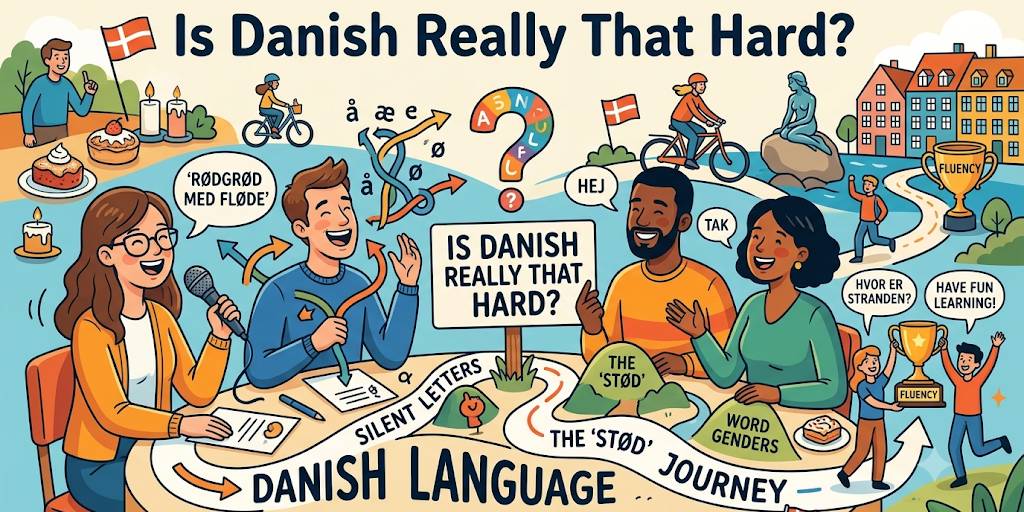
Is Danish Really That Hard? An Honest Answer for International Parents

If you’ve mentioned to anyone that you’re moving to Denmark, you’ve probably already heard it: “Danish is impossible.” “Even Danish toddlers struggle to learn it.” “You’ll never get the pronunciation right.”
Why Danish Has a Reputation for Being Difficult
There is actual linguistic research behind this reputation, and it’s worth understanding why. A well-known study called “Does sound structure affect word learning? An eye-tracking study of Danish learning toddlers” found that Danish children take longer to build vocabulary than children learning many other languages — not because Danish children are slower learners, but because Danish has an unusually high number of vowel sounds (around 20, depending on how you count) and a tendency to swallow consonants at the end of words.
Linguists call this phenomenon related to bløde konsonanter (soft consonants) — the way Danes often soften or drop the ends of words in casual speech. The result is that Danish sounds, to outsiders, like a continuous mumble rather than distinct words. This is genuinely one of the harder aspects of the language, for adults and children alike.
What Actually Makes Danish Hard (and What Doesn’t)
The Hard Parts:
- Pronunciation — Danish has many vowel sounds that don’t exist in most other languages, and several letters are barely pronounced at all
- The stød — a glottal stop that changes word meaning, with no real equivalent in English, Spanish, or Portuguese
- Listening comprehension — spoken Danish moves fast and words blend together more than the written form suggests
The Easier Parts:
- Grammar — Danish grammar is actually simpler than German or French in several ways: no noun cases, fairly consistent word order, fewer verb conjugations
- Vocabulary — Danish shares many roots with English and German, so once you start recognising patterns, vocabulary builds quickly
- Reading and writing — generally more approachable than the spoken language, especially for those who already read Latin-alphabet languages
Why Children Learn Danish Faster Than Adults
This is the part that should reassure you. Young children don’t “study” Danish the way adults do — they absorb it. Their brains are still wired for native-level phonetic acquisition, meaning they can hear and reproduce sounds that adult ears and mouths have already specialised away from.
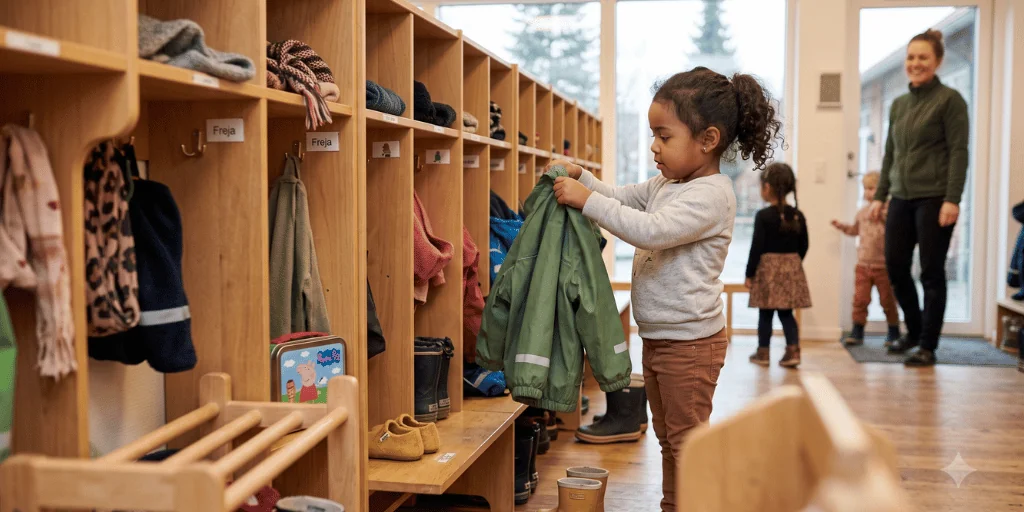
Children attending Danish børnehave (kindergarten) are immersed in the language for hours a day, surrounded by native speakers their own age, with no self-consciousness about getting it wrong. This combination — immersion, repetition, and low social pressure — is exactly the environment that adult language classes try, and usually fail, to replicate.
Most children who start kindergarten in Denmark before age 5 are functionally fluent within 6–12 months. That’s not a guarantee, but it’s a realistic, well-documented pattern.
So Should You Worry?
A little concern is healthy — it means you’ll be supportive. But the evidence is reassuring:
- Danish is hard for adults, especially around pronunciation
- Danish is much easier for young children, who acquire it through immersion rather than study
- The grammar — often the hardest part of a language for adult learners — is one of Danish’s easier features
- Consistent exposure, not perfection, is what predicts success at every age

📱 About the app
Want to give your child a head start before kindergarten, or extra support alongside it? Poikilingo Kids introduces Danish vocabulary and sounds through playful mini-games, so your child arrives already familiar with the words and rhythms they’ll hear every day at børnehave.
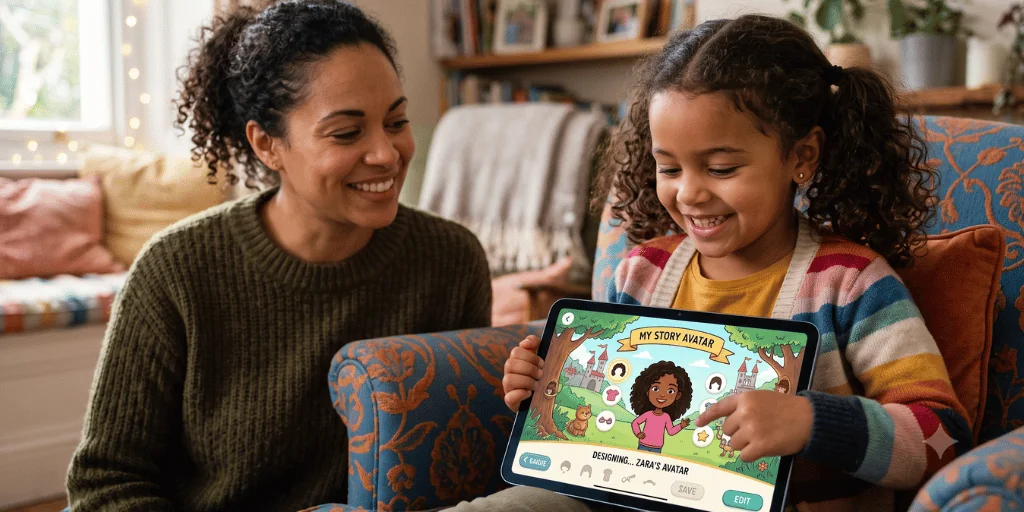
Poikilingo Kids is a Danish language learning app designed for children aged 3–5, created by international moms living in Denmark. Mini-games mirror real kindergarten (børnehave) routines, seasonal content, and a highly inclusive avatar system. 100% ad-free and child-safe. Available on iOS and Android.
🇩🇰 Danish for kids
🤩 Your kid as a character
💳 FREE trial, no credit card
🚫 No ads
👶🏼 Ages 3–6